A small entryway doesn’t have to feel cramped or overlooked. The wall space in a tight foyer is prime real estate for solving storage headaches, establishing visual flow, and setting the tone for the rest of the home. Unlike wide-open entryways where furniture anchors the design, small entries rely almost entirely on what goes on the walls. Done right, a 4-foot-wide entry corridor can feel organized, inviting, and twice as large as its actual footprint. This guide covers practical, tested approaches to dressing small entryway walls, no lifestyle fluff, just strategies that work.
Table of Contents
ToggleKey Takeaways
- Small entryway wall ideas maximize vertical storage through pegboard, slat walls, and modular rail systems that free up floor space while keeping coats, bags, and keys organized.
- Mount hooks 60–66 inches high for adults and 48 inches for children, spacing them 4–6 inches apart, and use toggle bolts or direct stud anchors for safety under coat weight.
- Mirrors are the most effective tool for visually enlarging a small entryway; position a 36-inch round or 24-by-36-inch rectangular mirror opposite a light source to reflect natural light and create depth.
- Gallery walls work best in narrow spaces when frames are scaled proportionally (4–6 frames of 8×10 or 11×14 inches in a 6-foot by 3-foot entry) and arranged vertically to elongate the wall.
- Accent paint in navy, charcoal, forest green, or terracotta adds richness and depth to small entryway walls without closing in the space, paired with satin or eggshell finishes for durability in high-traffic zones.
- Fold-down benches, magnetic boards, and wall-mounted drop-leaf tables turn small entryway walls into multi-functional features that serve storage and seating without consuming floor space.
Why Small Entryway Walls Matter More Than You Think
In homes with limited square footage, the entryway wall is the first vertical surface guests see, and the last thing residents interact with before leaving. It’s a high-traffic zone that absorbs keys, bags, coats, mail, and seasonal clutter. Without intentional design, it becomes a dumping ground.
Small wall space forces prioritization. Every hook, shelf, or decorative element must justify its presence. The upside? Thoughtful wall treatment in a compact entry creates functional density: more utility per square foot than a sprawling mudroom ever could. It also sets design expectations. If the entry feels cohesive, the rest of the home benefits from that visual credibility.
From a structural standpoint, most entryway walls in older homes are load-bearing and run perpendicular to floor joists. That means anchoring hardware into studs (typically spaced 16 inches on center) is non-negotiable for anything heavier than a lightweight frame. Use a stud finder before drilling, and remember that drywall anchors alone won’t support coat racks or shelving under real load. For renters, damage-free adhesive strips rated for the item’s weight are a safer alternative, though they won’t hold more than a few pounds.
Vertical Storage Solutions That Double as Decor
Small entryways benefit most from vertical storage, systems that climb the wall rather than encroach on floor space. Pegboard panels, slat walls, and modular rail systems let homeowners reconfigure hooks, baskets, and shelves as needs change. A 4-foot by 2-foot pegboard panel mounted to studs can hold coats, bags, umbrellas, and keys without permanent commitment to a single layout.
Slat wall systems (commonly 3-inch spacing) accept accessories like J-hooks, bins, and small shelves. These are popular in closets but work equally well in entries, especially when painted to match the wall color for a seamless look. Installation requires locating studs and using #8 wood screws long enough to penetrate at least 1 inch into the stud.
For a cleaner aesthetic, consider a wall-mounted entryway organizer with integrated hooks, a mail slot, and a narrow shelf. These typically measure 24 to 36 inches wide and 18 to 24 inches tall, and they consolidate multiple functions into one piece. Look for solid wood or plywood construction: particleboard units sag under coat weight within months.
Wall-Mounted Hooks and Floating Shelves
Wall-mounted hooks are the workhorse of small entryway design. Individual coat hooks should be mounted 60 to 66 inches from the floor for adult use, and 48 inches for children. Space hooks 4 to 6 inches apart to prevent coat overlap. Use toggle bolts or screw directly into studs for hooks rated to hold 10+ pounds.
Floating shelves add display and drop-zone utility. A single 24-inch shelf mounted 54 to 60 inches high provides a landing spot for keys, sunglasses, and mail without blocking sightlines. Standard floating shelf brackets support up to 50 pounds when anchored into studs, but confirm the bracket’s rated capacity, especially if stacking books or decorative pottery. Install shelves with a slight forward tilt (1-2 degrees) to prevent items from sliding off: this is especially useful in homes with uneven floors.
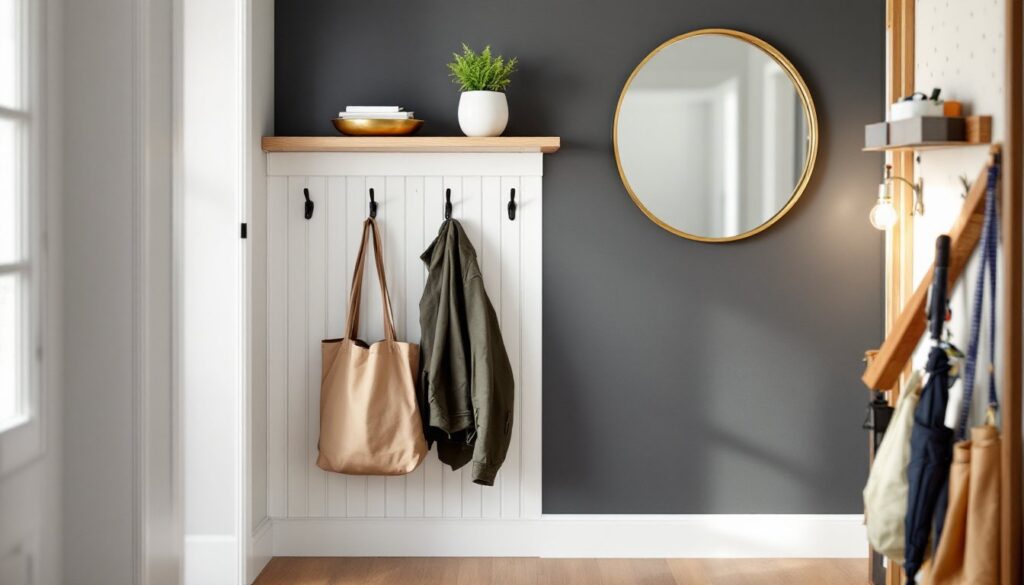
Combining hooks below a floating shelf creates a compact drop zone. Mount the shelf first, then position hooks 8 to 12 inches below the shelf’s underside to allow clearance for hanging items. This layered approach maximizes wall real estate without visual clutter.
Statement Mirrors to Expand Your Space Visually
Mirrors are the most effective tool for visually enlarging a small entryway. A 36-inch round or 24-by-36-inch rectangular mirror positioned opposite a window or light source reflects natural light and creates the illusion of depth. In narrow entries (less than 4 feet wide), a vertical mirror emphasizes ceiling height and draws the eye upward.
Mount mirrors 57 to 65 inches from the floor to center them at average eye level. For households with children, lower placement (48 to 54 inches) ensures usability for everyone. Use D-ring hangers and wall anchors rated for the mirror’s weight, glass is heavier than it looks. A 24-by-36-inch mirror with a wood frame can weigh 15 to 20 pounds, requiring two anchor points minimum.
Leaning mirrors (propped against the wall rather than hung) work in entries with baseboard clearance and low foot traffic, but they’re a tripping hazard in tight spaces. If leaning a mirror, secure the top edge to the wall with furniture straps to prevent tipping, especially in homes with pets or kids. Interior designers often recommend mirrors with modern finishes and slim profiles that complement contemporary entryway aesthetics without overwhelming the space.
Gallery Walls and Art Arrangements for Narrow Spaces
Gallery walls bring personality to small entryways without sacrificing function. The key is scale: frames should be proportional to the wall. In a 6-foot-tall by 3-foot-wide entry, a grid of four to six 8-by-10-inch or 11-by-14-inch frames feels intentional, while a single oversized piece can overwhelm.
Start by arranging frames on the floor to test composition. Use painter’s tape to mark frame positions on the wall before hammering nails. For a cohesive look, keep spacing between frames consistent, 2 to 3 inches is standard. Align the top or bottom edges of frames in a row for a clean, gallery-style presentation.
Vertical arrangements work best in narrow entries. A column of three to five frames running floor to near-ceiling height elongates the wall. Hang the center frame at 60 inches (standard eye level), then space remaining frames evenly above and below. Use picture-hanging wire and D-rings for frames heavier than 5 pounds: sawtooth hangers are fine for lightweight art but tend to slip over time.
For homes following current design trends, mixing frame styles and mat colors adds visual interest without formality. Black frames with white mats create high contrast, while natural wood tones soften the look in Scandinavian or coastal interiors. Avoid glass-front frames in high-traffic entries, they smudge easily and require constant cleaning.
Textured Wall Treatments and Accent Colors
Paint and texture transform small entryway walls from forgettable to memorable. Accent walls in bold or dark colors add depth without closing in the space, especially when the adjacent walls stay light. Navy, charcoal, forest green, and terracotta are common choices in 2026, offering richness without the starkness of pure black.
One gallon of paint covers roughly 350 to 400 square feet, so a typical 8-foot by 4-foot entryway wall requires less than a quart. Use satin or eggshell finishes for entryways: they’re more durable and wipeable than flat paint, which shows scuffs and handprints. Semi-gloss works well in high-traffic homes with kids or pets, though it amplifies wall imperfections.
Board-and-batten paneling is a popular textured treatment for small entries. Vertical battens (1×2 or 1×3 boards spaced 12 to 18 inches apart) add dimension and visual height. Install battens over painted drywall using a brad nailer and 1.5-inch nails into studs or construction adhesive for a no-nail approach. Paint the entire wall, battens included, in a single color for a modern look, or contrast the battens for a more traditional feel.
Peel-and-stick wallpaper offers pattern without commitment. It’s particularly useful in rentals or for homeowners testing bold designs. Application is straightforward: clean the wall, measure and cut panels, peel the backing, and smooth from top to bottom with a squeegee to eliminate bubbles. Quality peel-and-stick papers remove cleanly, though cheaper versions can leave residue. Test a small corner before covering the full wall. Many projects in creative spaces use removable wallpaper to add character without permanent changes.
Multi-Functional Wall Features for Tight Entryways
When floor space is non-existent, multi-functional wall features earn their keep. Fold-down benches (also called Murphy benches) mount flush to the wall and flip down for seating when needed. They’re ideal for shoe changes in entries too narrow for a permanent bench. Most fold-down designs require mounting to studs with heavy-duty hinges rated for 200+ pounds. Installation involves locating two studs 16 to 24 inches apart, attaching a cleat board, and securing the bench’s hinge plate. This isn’t a lightweight weekend project, expect two to three hours and basic carpentry skills.
Magnetic boards or chalkboard paint turn a section of wall into a message center. Magnetic primer (applied before topcoat) allows magnets to stick to any painted surface, though it requires two to three coats for strong hold. Chalkboard paint is easier: two coats over primed drywall, followed by a three-day cure before first use. Both options add function without protruding into walkways.
Narrow console alternatives include wall-mounted drop-leaf tables or floating desks that double as key drop zones. A 10-inch-deep shelf with a hinged leaf can expand to 20 inches when needed, then fold flat. These require piano hinges and support brackets mounted into studs. For renters or those avoiding wall penetration, freestanding ladder shelves (leaning style, 12 to 14 inches deep) are a no-install option, though they do occupy floor space.
In homes where entryway storage intersects with broader interior layouts, combining wall features with strategic decor choices creates a unified aesthetic. Always prioritize structural integrity, small entryways see heavy use, and poorly anchored features fail fast. If a project involves electrical work (adding sconces or outlets), consult local codes and consider hiring a licensed electrician. The National Electrical Code (NEC) has specific requirements for receptacle placement in entryways, and DIY electrical work may void homeowners insurance in some jurisdictions.
For wall treatments that involve removing existing finishes or patching drywall, proper surface prep is non-negotiable. Sand, prime, and ensure walls are clean and dry before applying paint, wallpaper, or adhesive-backed products. Most DIY failures in entryway projects stem from skipping these steps, not from the installation itself.