Living in an RV means rethinking every square inch, especially in the kitchen. Unlike a stick-and-brick home where you can add another cabinet or island, RV kitchens demand ruthless efficiency. The good news? Constraints breed creativity. With the right storage hacks, compact appliances, and multi-purpose fixtures, even a galley-style RV kitchen can handle meal prep for a family of four. This guide walks through practical, proven upgrades and organizational strategies that maximize function without requiring a full gut renovation. Most of these ideas can be tackled in a weekend with basic hand tools.
Table of Contents
ToggleKey Takeaways
- Smart storage and ruthless decluttering form the foundation of any small RV kitchen—use drawer dividers, pull-out shelves, and vertical racks to maximize the 25–40 square feet of usable space.
- Space-saving appliances like microwave-convection combos, two-burner induction cooktops, and 6-quart Instant Pots deliver full functionality without sacrificing the counter and cabinet room needed for food prep.
- Small RV kitchen ideas like sink covers, fold-down wall tables, and slide-out cutting boards can nearly double your prep surface area without requiring a full renovation.
- Vertical storage solutions—including magnetic knife strips, pegboards, S-hooks, and tension rods—transform unused wall space into high-capacity organizers when floor and cabinet space are maxed out.
- Multi-purpose furniture such as folding tables, storage ottomans, and rolling kitchen carts lets every piece pull double or triple duty in tight galley kitchens.
- Light colors, natural lighting, glass-front cabinets, and minimal countertop clutter create the perception of a larger space while making your RV kitchen feel more functional and welcoming.
Why Smart Storage Is the Foundation of Any Small RV Kitchen
Before swapping appliances or repainting cabinets, start with ruthless decluttering and intentional storage design. RV kitchens average 25–40 square feet of usable space, so every item needs to justify its spot.
Begin by auditing what’s actually used. Most RVers carry duplicate utensils, novelty gadgets, and mismatched containers that waste precious volume. Nest cookware: a 10-inch skillet should fit inside a 12-inch, with pot lids stored vertically in a narrow rack. Swap bulky spice jars for magnetic tins that mount to the range hood or fridge side.
Drawer dividers are non-negotiable. Use spring-loaded or foam-insert organizers to prevent rattling during travel. For cabinets, install pull-out shelves or lazy Susans to access back corners without unpacking half the pantry. Many RV cabinets have dead space above the top shelf, add a second tier with wire racks or adhesive hooks.
Don’t overlook the toe-kick zone under cabinets. That 4-inch gap can house a shallow drawer on slides for baking sheets or cutting boards. Same goes for the gap between the fridge and wall: a rolling pantry cart (6–8 inches wide) captures otherwise wasted inches.
Finally, secure everything for travel. Use bungee cords, tension rods, or childproof latches. A flying can of beans at highway speed is both dangerous and messy.
Space-Saving Appliances That Don’t Sacrifice Functionality
Downsizing appliances doesn’t mean giving up hot meals. Modern compact units rival full-size performance in a fraction of the footprint.
Swap a standard microwave for a microwave-convection combo unit. Brands like Thetford and Furrion make 0.9–1.2 cubic foot models that bake, roast, and crisp, eliminating the need for a separate oven. Mount it above the range or in an upper cabinet to free counter space.
For cooktops, consider a two-burner induction plate over propane. Induction heats faster, uses less power (when shore or solar is available), and doesn’t add propane weight or tank swaps. If sticking with propane, opt for a drop-in cooktop with a flush cover that doubles as extra counter space when not cooking.
Under-counter refrigerators (3–4 cubic feet) fit under a galley counter and leave room for overhead storage. Some RVers replace the factory fridge with a 12-volt compressor model, which runs efficiently off solar and doesn’t require leveling like absorption fridges.
Instant Pots and multi-cookers are RV MVPs. A 6-quart model pressure-cooks, slow-cooks, sautés, and makes rice, replacing four separate appliances. Many small kitchen organization tips emphasize choosing tools that perform multiple roles, and this principle is doubly true in mobile living.
Skip the full-size dishwasher. Countertop models exist, but they’re bulky and water-hungry. A collapsible dish tub and drying mat are lighter, cheaper, and easier to stow.
Creative Countertop Solutions for Minimal Square Footage
RV countertops are notoriously small, often less than 3 square feet of usable prep area. Expanding work surface without a full remodel requires creativity.
Install a sink cover (also called a cutting board insert). These slip over the basin, adding 12–18 inches of workspace. Look for bamboo or composite models with a drain hole for rinsing veggies. When not in use, they store vertically in a narrow cabinet slot.
A fold-down wall table mounted to a cabinet side or blank wall provides an extra 12 × 18-inch surface. Use heavy-duty folding brackets rated for at least 50 pounds. Some RVers hinge a section of countertop to flip up when needed, supported by a collapsible leg.
Slide-out cutting boards tucked under the counter edge are classic, but make sure the slides are rated for RV vibration (ball-bearing slides, not plastic tracks). Add a lip or groove to prevent sliding during travel.
For stove covers, choose tiered or nesting designs that create a flat surface but still allow quick burner access. Some models include a removable cutting board layer.
Avoid cluttering permanent countertop space with appliances. Store toasters, coffee makers, and blenders in lower cabinets and pull them out only when needed. If a coffee maker is used daily, mount it under an upper cabinet with a swing-arm bracket.
Consider countertop material upgrades if renovating. Butcher block is warm and can be sanded/refinished, but requires sealing. Thin quartz or solid surface adds durability without the weight of granite. Laminate remains the lightest and most budget-friendly option.
Vertical Storage Hacks to Free Up Cabinet Space
When floor and counter space are maxed out, the only direction left is up. Vertical storage transforms unused wall area into high-capacity organizers.
Mount a magnetic knife strip or utensil bar on the backsplash or inside a cabinet door. This frees an entire drawer. Pegboards work well for spatulas, measuring cups, and pot holders, use metal pegs or 3D-printed hooks for custom layouts.
Install S-hooks or rails under upper cabinets to hang mugs, dish towels, or small baskets. Many small space solutions recommend utilizing the undersides of shelves and cabinets, which is especially critical when square footage is tight.
Use the inside of cabinet doors for spice racks, pan lids, or cleaning supplies. Adhesive-mount wire racks (rated for RV vibration) work if you’re renting or don’t want to drill. For owned rigs, screw-mount is more secure.
Tension rods installed vertically in cabinets create dividers for baking sheets, cutting boards, or pot lids. Horizontal rods near the ceiling can hold lightweight bins or hanging organizers.
Over-the-door organizers aren’t just for bedrooms. A slim hanging rack on the pantry or bathroom door holds snacks, foil, plastic wrap, or Ziploc bags.
For pots and pans, a ceiling-mounted pot rack saves huge cabinet volume, but only if your RV ceiling can handle the load and you have adequate headroom. Check joist location and use lag bolts into solid wood, not just the ceiling panel. Expect to hold 20–30 pounds safely.
Finally, stackable shelves inside cabinets double usable height. Look for adjustable models that fit various cabinet depths.
Multi-Purpose Furniture and Fixtures for RV Kitchens
In small RV kitchens, every piece should pull double or triple duty. Single-function furniture is a luxury you can’t afford.
Replace a standard dinette with a folding or drop-leaf table that expands for meals and collapses for floor space. Some RVers install a wall-mounted fold-down table that completely disappears when not in use.
Use storage ottomans or bench seating with lift-up lids. These provide extra seating, hidden storage for linens or dry goods, and can double as a step stool to reach upper cabinets.
A rolling kitchen cart serves as a mobile island, extra pantry, or bar cart. Look for models with a butcher block top, shelves, and locking casters. When parked, it’s a prep station: while traveling, it tucks beside the fridge or in a slide-out.
Consider a fold-down dish rack that mounts over the sink or a collapsible silicone model that stores flat. Both free up permanent counter real estate.
Swap standard cabinet doors for curtains or roll-up slat doors to reduce swing radius and make tight galleys more navigable. Curtains also weigh less and won’t slam during travel.
If renovating, install a hideaway or pull-out pantry between the fridge and wall, a narrow slide-out on full-extension drawer glides. These are common design essentials in efficient small kitchens and translate perfectly to RV use.
Finally, use your RV’s unique features. Some fifth wheels have a “basement” under the kitchen, install slide-out bins for bulk pantry items or seasonal cookware.
Design Tips to Make Your Small RV Kitchen Feel Larger
Physical space is fixed, but perception of space is flexible. Smart design choices trick the eye into seeing more room.
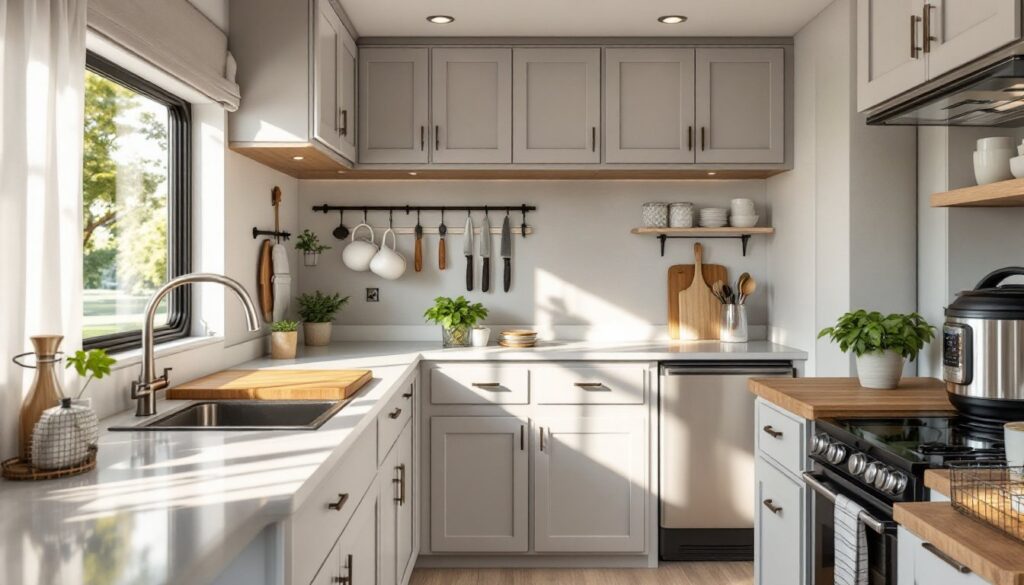
Light colors expand. White or light-gray cabinets, pale countertops, and neutral backsplashes reflect light and reduce visual weight. If you’re repainting cabinets, use a high-adhesion primer formulated for laminate or melamine, then a durable semi-gloss or satin finish. Prep is critical, clean with TSP, sand lightly, and allow full cure time.
Maximize natural light. Swap heavy curtains for sheer shades or cafe-style half curtains. Add battery-powered LED puck lights under cabinets to brighten work surfaces without adding electrical load.
Use glass-front or open upper cabinets to create visual depth. This works best if the contents are organized and attractive, mismatched plastic containers will have the opposite effect.
Mirrors or reflective backsplashes amplify light and space. Peel-and-stick mirror tiles or stainless steel sheets are easy installs.
Keep counters as clear as possible. Appliances, soap dispensers, and sponge holders all shrink the perceived work area. Aim for less than three items on permanent display.
Consistent flooring between kitchen and living areas eliminates visual breaks that chop up space. If replacing flooring, luxury vinyl plank (LVP) is lightweight, water-resistant, and available in wood or tile looks.
Finally, edit decor ruthlessly. One or two well-chosen pieces (a potted herb, a small piece of art) add personality. A dozen tchotchkes create clutter.
Avoid heavy window treatments, dark cabinetry, and busy patterns. Even if your RV came with oak cabinets and floral wallpaper, a weekend of painting and peel-and-stick wallpaper can transform the space.
Conclusion
Maximizing a small RV kitchen isn’t about buying more stuff, it’s about choosing the right stuff and using every surface intentionally. Start with smart storage and ruthless decluttering, then layer in compact appliances, vertical organizers, and multi-purpose fixtures. Most of these upgrades require only basic tools and a weekend of work. Whether you’re a weekend camper or a full-timer, a well-organized galley makes life on the road dramatically better.