When floor space is at a premium, a stacked washer dryer setup can turn a cramped closet or corner into a fully functional laundry room. These vertical configurations free up square footage for storage, folding stations, and other essentials without sacrificing cleaning power. But stacking appliances is just the first step, the real challenge is designing around them to create a space that’s both efficient and easy to use. This guide covers layout ideas, storage hacks, and finishing touches that help homeowners make the most of every vertical inch in their laundry areas.
Table of Contents
ToggleKey Takeaways
- Stacked washer dryer units occupy just 24–27 inches wide compared to 48+ inches for side-by-side models, making them ideal for small laundry rooms, closets, and narrow spaces.
- Vertical storage solutions like floor-to-ceiling cabinetry, wall-mounted shelving, and pull-out towers maximize functionality around stacked appliances without sacrificing door swing or ventilation.
- Placing the dryer at chest height eliminates bending during load transfers, offering significant ergonomic benefits for homeowners with mobility concerns.
- Fold-down wall-mounted tables and pull-out shelves create practical folding stations in tight quarters, requiring minimal permanent floor space.
- Proper ventilation with rigid metal ducts (25-foot maximum length) and clearance of at least 1 inch around appliances prevents lint buildup, mold growth, and fire hazards.
- Stacked washer dryer laundry rooms can be concealed with bifold or barn doors, or showcased with accent colors and decorative trim, depending on design preferences and room layout.
Why Stacked Washer Dryers Are Perfect for Small Laundry Rooms
Stacked washer dryer units occupy roughly 24 to 27 inches wide and about 70 to 76 inches tall when combined, compared to side-by-side setups that require at least 48 inches of width. That difference opens up opportunities for narrow closets, hallway nooks, or bathroom alcoves that would otherwise sit unused.
Many manufacturers now offer unitized stacked combos (factory-stacked) or separate front-load washers and dryers designed to stack with a stacking kit. Factory-stacked units are typically 27 inches wide, while separate stackables range from 24 to 27 inches. Both configurations deliver full-size capacity, usually 4.0 to 5.3 cubic feet for the washer and 7.0 to 7.4 cubic feet for the dryer, so homeowners aren’t trading performance for space savings.
From a code perspective, stacked units require adequate clearance for door swing, ventilation access, and front panel servicing. The IRC recommends at least 1 inch of clearance on sides and back for air circulation, though specific manufacturer specs may vary. Always check the installation manual before framing or cabinetry work begins.
Another advantage: stacked setups place the dryer at chest height, eliminating the need to bend down to transfer loads. For homeowners with mobility concerns, this ergonomic benefit is significant.
Vertical Storage Solutions That Work Around Your Stacked Unit
With appliances climbing the wall, the space beside and above them becomes prime real estate for shelving, cabinets, and hooks. The key is designing storage that doesn’t interfere with appliance operation or ventilation.
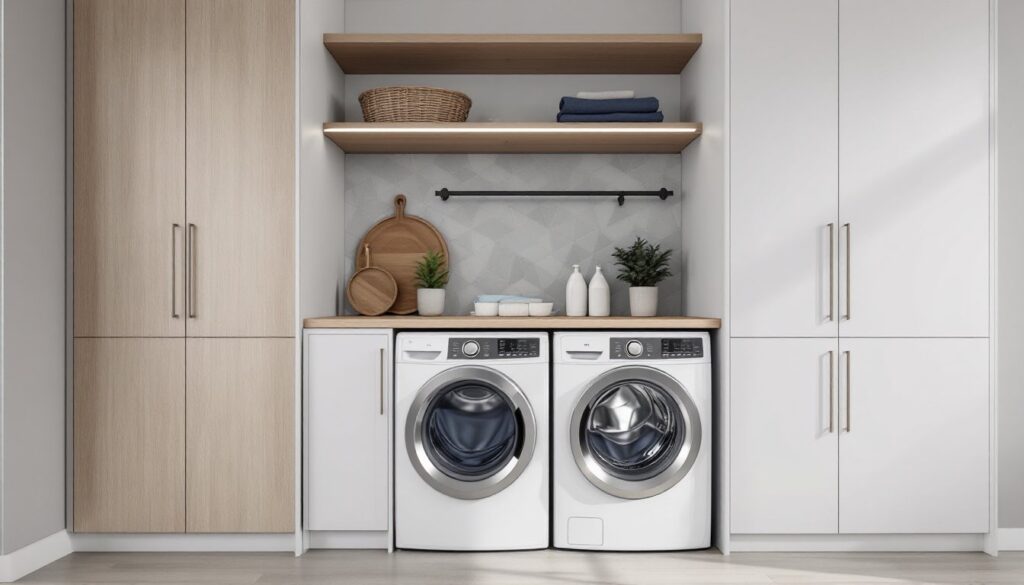
Floor-to-ceiling cabinetry flanking the stacked unit is a popular choice. Upper cabinets (36 to 42 inches tall) can hold detergent, dryer sheets, and stain removers, while lower cabinets (24 to 30 inches) store cleaning supplies or laundry baskets. Use 12- to 18-inch-deep cabinets to keep the room from feeling cramped, and install soft-close hinges to avoid rattling during spin cycles.
If cabinetry isn’t in the budget, wall-mounted wire shelving or industrial-style brackets with wood shelves provide similar function at a fraction of the cost. Position shelves at least 6 inches above the dryer to avoid heat buildup, and keep the depth to 12 inches so they don’t obstruct door swing.
For narrow spaces, a pull-out pantry tower (6 to 10 inches wide) fits between the appliance and wall, offering slim storage for bottles and spray cleaners. These towers typically mount on full-extension drawer slides rated for at least 75 pounds.
Don’t overlook the back of the door. Over-the-door organizers with pockets or hooks hold iron cords, lint brushes, and mesh laundry bags without taking up wall space. Choose a model with rubberized hooks to protect the door finish.
Finally, consider a rolling cart with slim profile (12 to 15 inches wide) that tucks beside the stacked unit. This works especially well in closet laundry rooms where permanent shelving isn’t an option.
Design Ideas for Closet Laundry Rooms with Stacked Appliances
Closet laundry rooms demand creative thinking to balance function and aesthetics. Start by removing the existing closet doors and framing the opening to accommodate either bifold doors, pocket doors, or barn-style sliders. Bifolds work best in tight hallways where door swing is limited, while pocket doors disappear completely when open, ideal for creating a seamless look.
If the closet lacks electrical outlets, hire a licensed electrician to install a 20-amp dedicated circuit for the washer (required by NEC 210.11) and a separate 30-amp, 240-volt circuit for electric dryers. Gas dryers need a 120-volt outlet plus a gas line run by a licensed plumber or gas fitter.
When designing storage for a small closet laundry setup, use the upper portion above the dryer for a single shelf or small cabinet. This space is perfect for items used occasionally, extra hangers, seasonal linens, or backup supplies.
Lighting is critical in closets. Install a flush-mount LED fixture rated for at least 800 lumens on the ceiling, and consider an under-shelf LED strip for task lighting. Motion-sensor switches add convenience when hands are full.
For a polished finish, frame out the closet opening with 3½-inch casing and paint it to match adjacent trim. If the washer and dryer remain visible, choose appliances in white, black, or stainless finishes that coordinate with the home’s existing palette.
Adding Folding Stations and Countertops in Tight Spaces
A countertop beside a stacked unit transforms a laundry room into a true workspace. Standard countertop height is 36 inches, but in tight quarters, a wall-mounted fold-down table or narrow ledge can deliver the same function.
For permanent installations, butcher block, laminate, or quartz countertops work well. Butcher block (typically 1½ inches thick) requires sealing with mineral oil or polyurethane to resist moisture. Laminate is budget-friendly and available in hundreds of colors, though edges can chip over time. Quartz is the most durable and water-resistant but costs more, expect $50 to $150 per square foot installed, depending on region and fabricator.
If the room is too narrow for a permanent counter, a wall-mounted fold-down table (also called a Murphy table or flip-down shelf) mounts on heavy-duty bracket hinges rated for at least 100 pounds. When not in use, it folds flush against the wall. Aim for a folded depth of 2 to 3 inches and a table surface of at least 24 inches wide by 18 inches deep for practical folding space.
Another option: install a pull-out cutting board or shelf between wall studs using full-extension slides. This requires opening the wall and adding blocking between studs for slide attachment, but it’s a clever use of otherwise dead space.
Top manufacturers now design stackable washer-dryer pairs with flat tops specifically to support small countertop surfaces or storage trays. If the dryer top is flat and stable, a ¾-inch plywood or MDF platform cut to size and finished with contact paper or paint can serve as a temporary folding surface.
Stylish Ways to Conceal or Showcase Your Stacked Washer Dryer
Whether to hide or highlight a stacked washer dryer depends on the room’s layout and the homeowner’s design preferences. Both approaches can look polished if executed well.
To conceal the appliances, install bifold or sliding barn doors across the opening. Bifolds are classic and space-efficient, while barn doors add farmhouse or industrial flair. Use a barn door track rated for the door’s weight, expect a solid-core door to weigh 60 to 80 pounds, and mount it to blocking in the wall or directly to studs.
For a built-in look, frame the appliance nook with matching cabinetry on either side and add a header or crown molding across the top. Paint everything the same color as surrounding walls to make the setup feel integrated rather than tacked on.
If showcasing the appliances, treat the nook like an accent wall. Paint the back wall in a bold color or apply peel-and-stick tile for texture. Removable wallpaper with geometric or botanical prints adds pattern without long-term commitment, just avoid placing it directly behind the dryer vent, where heat and humidity can loosen adhesive.
Some homeowners frame the appliance opening with decorative trim or picture frame molding to create a gallery-like effect. This works best when appliances have sleek, modern finishes that coordinate with the room’s palette.
Finally, if the laundry area sits in a high-traffic zone, consider a fabric curtain on a tension rod for budget-friendly concealment. Choose a washable cotton or linen blend in a color that ties into adjacent rooms. This solution won’t muffle noise, but it softens the visual impact.
Lighting and Ventilation Tips for Stacked Laundry Setups
Proper lighting and ventilation aren’t just conveniences, they’re essential for safety and appliance longevity. Dim, poorly ventilated laundry spaces lead to mold growth, lint buildup, and increased fire risk.
Lighting: Overhead lighting should provide at least 50 foot-candles of illumination for detailed tasks like stain removal and sorting. A 60- to 75-watt equivalent LED flush-mount fixture typically delivers this level. If the ceiling height allows, a semi-flush fixture with a diffuser reduces shadows.
For task lighting, mount an under-cabinet LED strip or puck lights beneath any upper shelving. Battery-operated puck lights work in closets without easy electrical access, though hardwired options provide consistent brightness.
Ventilation: Electric dryers produce moisture and heat, while gas dryers also generate combustion byproducts. The IRC requires dryer exhaust ducts to terminate outdoors, with a maximum length of 25 feet for straight runs (subtract 2.5 feet for each 45-degree elbow and 5 feet for each 90-degree elbow).
Use rigid metal duct (aluminum or galvanized steel) rather than flexible foil or vinyl duct, which can trap lint and pose a fire hazard. Clean the duct annually using a dryer vent brush kit or hire a professional duct cleaning service.
If the laundry area lacks a window, consider a ventilation fan to manage humidity. A fan rated for at least 50 CFM (cubic feet per minute) helps prevent mildew on walls and surrounding cabinetry. Mount it on an exterior wall with a vent cap, and wire it to a timer or humidity-sensing switch for automatic operation.
Always leave at least 1 inch of clearance on sides and back of stacked appliances for air circulation, per manufacturer guidelines. Blocking airflow can cause overheating and void warranties.
Conclusion
Stacked washer dryer setups prove that small laundry rooms can be just as functional, and stylish, as full-size laundry areas. By maximizing vertical storage, adding smart folding surfaces, and addressing lighting and ventilation from the start, homeowners can create a space that handles weekly loads without wasting square footage. Whether tucked into a closet or integrated into a hallway nook, a well-designed stacked laundry room is proof that thoughtful planning beats extra space every time.